
Aafreen Hussain in KOLKATA
The Trinamool Congress’ 33rd Martyrs’ Day observance on Monday was marked by high political drama, emotional tributes and sharp attacks on the BJP as former West Bengal Chief Minister Mamata Banerjee used the annual July 21 platform to send a strong message to both her political opponents and leaders who have deserted the party.
The annual programme commemorates the 13 Youth Congress workers who were killed in police firing during the “No Identity Card, No Vote” movement on July 21, 1993, when the Left Front government led by Jyoti Basu was in power. Since founding the Trinamool Congress, Mamata Banerjee has observed the day as Martyrs’ Day. This year, however, the programme assumed greater political significance following the party’s split after the 2026 Assembly elections, with rival Trinamool factions holding separate events across Kolkata.
The day began amid controversy after the Trinamool alleged that its main stage near Birla Planetarium had been vandalised late on Monday night. Mamata Banerjee, along with senior leaders including Derek O’Brien, Mahua Moitra and Dola Sen, rushed to the venue and remained there overnight while the damaged stage was rebuilt. The party alleged that the incident was a deliberate attempt to disrupt the Martyrs’ Day programme, although no official confirmation regarding those allegations was immediately available.
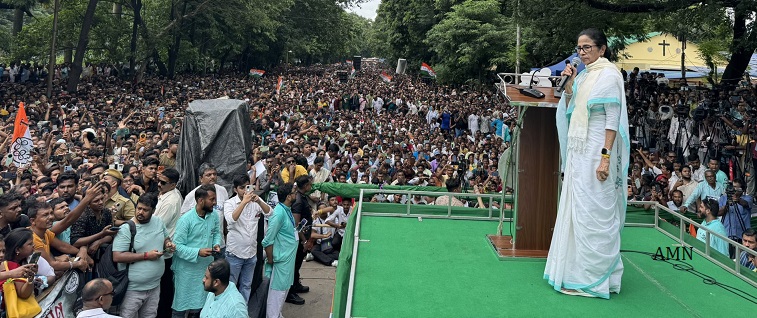
Despite the overnight controversy, thousands of party workers and supporters gathered at the Birla Planetarium venue for the main rally.
Addressing the gathering, Mamata Banerjee declared that the Trinamool Congress would continue its political battle against the BJP with renewed determination. She announced that she would tour every district of West Bengal to reconnect with party workers and supporters and said that, if necessary, she would also travel to New Delhi to participate in protests against the BJP.
A major highlight of her speech was her uncompromising stand on party rebels. Endorsing National General Secretary Abhishek Banerjee’s earlier appeal, she categorically ruled out the return of leaders who had left the party.
“Those who want to join the BJP are free to go. The more they leave, the happier we will be. We have enough students and young workers to replace every vacant position. Those who have gone have chosen their path, and they will not be taken back,” she declared.
Without naming individuals, Mamata also alleged that she knew those responsible for attempts to weaken the party from within and warned that the Trinamool would continue its political struggle until such “threats” were eliminated.
Referring to issues such as Lakshmir Bhandar, the Dearness Allowance agitation and the eviction of hawkers, she accused the BJP government of targeting ordinary people and attempting to erase the Trinamool’s political identity. She asserted that if any effort was made to deprive the party of its election symbol, she would challenge the matter in the Supreme Court and pursue every constitutional remedy available.
Expressing gratitude to the families of the July 21 martyrs, Mamata thanked them for attending the programme despite what she described as pressure, inducements and intimidation. She also acknowledged the Calcutta High Court for granting permission for the rally and appealed to supporters to remain calm after brief congestion developed near the stage, warning that overcrowding could lead to accidents.
This year’s July 21 observance reflected both the Trinamool Congress’ internal challenges and its efforts to reorganise after recent political setbacks. While rival factions organised separate programmes, Mamata Banerjee used the occasion to project unity within her camp, reaffirm her leadership and signal an aggressive political campaign in the months ahead.
The rally also raises important political questions. Will Mamata Banerjee’s hardline rejection of returning rebels strengthen organisational discipline, or further deepen divisions within the Trinamool Congress? Can her renewed statewide campaign revive the party’s political fortunes? And as multiple factions claim the legacy of July 21, who will ultimately command the confidence of the party’s grassroots in the evolving political landscape of West Bengal?