
Last Updated on April 13, 2026 12:44 am by INDIAN AWAAZ
Our Correspondent / New Delhi
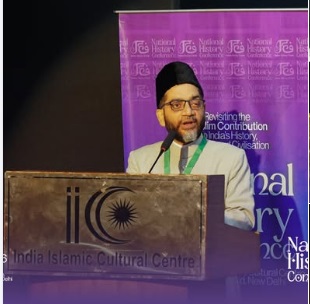
Prominent Islamic scholar and Jamaat-e-Islami Hind Chief Syed Sadatullah Husaini has raised serious concerns over what he described as the systematic erasure and distortion of Muslim contributions from India’s historical narrative.
Speaking at a conference hosted by the Indian History Forum in Delhi on April 11 and 12, Husaini warned that “collective amnesia” could weaken the nation’s identity and future.
Addressing a gathering of scholars, academicians and public intellectuals, Husaini stressed that history is not merely about the past but plays a decisive role in shaping the present and future. “Every nation lives twice—once in reality and once in memory. Reality follows memory,” he said, underlining that what a society chooses to remember or forget ultimately defines its trajectory.
He argued that India today is facing a dangerous trend where significant portions of Muslim history are being “deleted from textbooks, discussions, debates, and the collective memory of the country.” According to him, this erasure is not incidental but part of a broader pattern of distortion that undermines an accurate understanding of India’s civilisational evolution.
Husaini identified three key ways in which history is being manipulated—deletion, distortion and generalisation. While deletion removes facts altogether, distortion misrepresents them, and generalisation reduces complex historical realities into simplistic stereotypes. “All three are at play today,” he said, pointing to how selective narratives are often amplified through media, films and digital platforms.
He also warned against the rise of what he termed a “post-truth” environment, where history is increasingly curated, amplified and even weaponised. In such a climate, he said, narratives are shaped less by evidence and more by ideological preferences and algorithm-driven visibility. “This kind of history does not enlighten—it misguides, divides and weakens the nation,” he cautioned.
Emphasising the need for neutrality and realism, Husaini called for history to be studied without bias or preconceived notions. He criticised the tendency to divide historical figures into simplistic binaries of “heroes” and “villains,” arguing that such approaches damage collective memory and hinder critical understanding.
The scholar also highlighted that the contributions of Muslims to India are not marginal but central to the country’s historical and cultural development. “Muslims are not appendices to Indian history; they are co-authors of its civilisational journey,” he asserted. From trade and economy to arts, language, governance and knowledge systems, he said Muslim communities have played a vital role in shaping India’s growth.
He pointed to historical periods when India was a major global economic power, noting that during the Mughal era, the country contributed significantly to global GDP and industrial production. He also emphasised the role of Muslim networks in connecting India to global trade routes and knowledge systems, particularly through the Indian Ocean, which he described as a “highway of ideas and coexistence.”
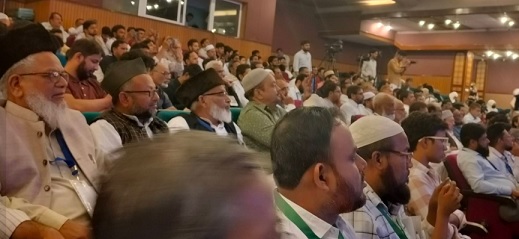
Husaini further highlighted the emergence of cultural and linguistic synthesis, citing the development of Urdu as an example of how diverse traditions blended to create new forms of expression. He also drew attention to inclusive markets and institutions that enabled participation across communities, as well as contributions to urban development and governance.
Importantly, he stressed that the objective of revisiting history is not to glorify any one community but to restore truth and ensure factual accuracy. “If history becomes propaganda, society loses both its memory and its ability to think critically,” he said.
Concluding his address, Husaini underscored that the study of history is a collective responsibility. He called for a sincere and evidence-based engagement with the past, warning that neglecting or distorting historical truth could have lasting consequences for national unity and identity.