
Last Updated on February 1, 2026 1:24 pm by INDIAN AWAAZ
ANDALIB AKHTER
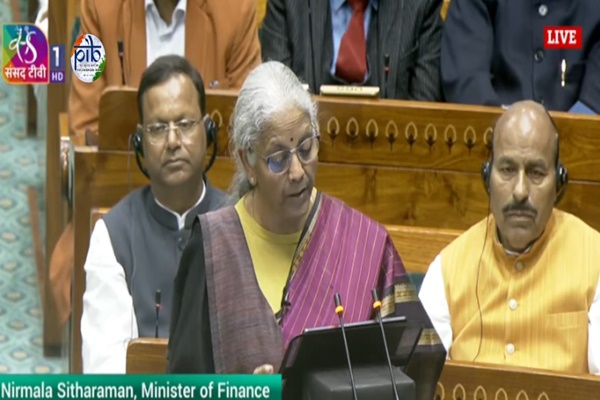
Finance Minister Nirmala Sitharaman presented the Union Budget 2026–27 in Parliament today, marking her ninth straight budget presentation — a record for an Indian finance minister.
Sitharaman Budget 2026-27 emphasized on infrastructure modernization, technology integration (especially AI), agricultural support, digital tourism, and targeted fiscal support for growth and job creation — all geared toward sustained economic momentum and long-term strategic goals.
In her Union Budget speech on Sunday, Finance Minister Nirmala Sitharaman pegged fiscal deficit at 4.3 per cent of the GDP for the year 2026-27, as against 4.4 per cent being targeted in 2025-26.
The difference between total revenue and total expenditure of the government is termed as the fiscal deficit.
It is an indication of the total borrowings that may be needed by the government.
The government had intended to bring the fiscal deficit below 4.5 per cent of GDP by the financial year 2025-26, and is on the path to achieving it.
The Union government in the Budget for 2026-27 has outlined a comprehensive economic roadmap aimed at strengthening India’s self-reliance while keeping the country firmly integrated with global markets.
To sustain and accelerate the economic momentum, Finance Minister Sitharaman has identified seven key areas for intervention. These include scaling up manufacturing across seven strategic and frontier sectors and promoting city-based economic regions as new engines of growth.
As part of its sector-specific initiatives, the government has announced plans to position India as a global hub for bio-pharmaceutical manufacturing. A new programme, Bio Pharma Shakti, with an outlay of Rs 10,000 crore over five years, aims to build a strong ecosystem for the domestic production of biologics and biosimilars.
In the technology and minerals space, the government has announced the launch of India Semiconductor Mission 2.0, alongside industry-led research and training centres to build a skilled workforce.
HIGHLIGHTS:
- Budget 2026-27 focuses on capacity building and reforms; Finance Minister NirmalaSitharaman calls it Yuva Shakti-driven Budget.
- Finance Minister says budget inspired by 3 kartavya of accelerating economic growth, to fulfil aspirations of our people building their capacity and aligned with vision of SabkaSath, SabkaVikas,to ensure that every family, community, region and sector has access to resources, amenities and opportunities.
- Proposal to launch the Mahatma Gandhi Gram Swaraj initiative to strengthen khadi, handloom and handicrafts. For Textile Sector, the budget proposes Integrated Programme with National Fibre Scheme and National Handloom and Handicraft programme to set up Mega Textile Parks.
- The Finance Minister introduces a dedicated 10 thousand crorerupees SME Growth Fund, to create future Champion SMEs incentivizing enterprises based on select criteria.
- Ms Sitharaman says an Infrastructure Risk Guarantee Fund to be established to provide prudently calibrated partial credit guarantees to SME lenders.
- 10 thousand crore rupees outlay for Biopharma SHAKTIto build the ecosystem for domestic production of biologics and biosimilarsover 5 years of period; Three new National Institutes of Pharmaceutical Education and Research, upgrading 7 existing ones.
- The Finance minister presenting her 9th budget in row, proposes to increase outlay of Electronics Components Manufacturing Scheme to 40 thousand crore rupees.
- Three dedicated Chemical Parks to be established to promote mining, processing, research and manufacturing.
- Ms Sitharaman presenting the budget in LokSabha,proposes a Scheme for Container Manufacturing with outlay 10 thousand rupeescrore over a 5 year period.
- Budget proposes to increasePublic Capexto 12.2 lakh crorerupees to continue focus on developing infrastructure especiallyin cities with over 5 lakh population.
- Establishment of new Dedicated Freight Corridors connecting Dankuni in the East, to Surat; Tooperationalise 20 new National Waterways over next 5 years, starting with NW-5 in Odisha to connect mineral rich areas of Talcher and Angul.
- Further, a ship repair ecosystem catering to inland waterways will also be set up at Varanasi and Patna;Also to launch a Coastal Cargo Promotion Scheme for incentivising amodal shift from rail and road.
- An outlay of 20 thousand crore rupees proposed over the next 5 years for Carbon Capture Utilization and Storage across power, steel, cement, refineries and chemicals.
- Seven High-Speed Rail corridors to be developed between Mumbai and Pune, Pune to Hyderabad, Hyderabad to Bengaluru, Hyderabad to Chennai, Chennai to Bengaluru, Delhi to Varanasi, and Varanasi to Siliguri.
- The government decides to set up High Level Committee on Banking for Viksit Bharat to review the banking sector.
- Individual Persons Resident Outside India (PROI) to be permitted to invest in equity instruments of listed Indian companies through the Portfolio Investment Scheme.
- The government to set up high-powered Education to Employment and Enterprise’ Standing Committee to focus on the services sector as a core driver of Viksit Bharat.
- Basic customs duty exempted on 17 drugs and medicines for cancer patients.
- Government to provide support for five Regional Medical Hubs to promote India as a hub for medical tourism.
- Three new All India Institutes of Ayurveda to be established to prepare more skilled health personnel.
- Government to provide support to the Indian Institute of Creative Technologies, Mumbai in setting up AVGC Content Creator Labs in 15 thousand secondary schools and 500 colleges.
- Centre to provide support in creating five University Townships in the vicinity of major industrial and logistic corridors.
National Destination Digital Knowledge Grid will be established to digitally document significant heritage sites. - The government to launch a Khelo India Mission to transform the Sports sector over the next decade.
- Scheme for Development of Buddhist Circuits in Arunachal Pradesh, Sikkim, Assam, Manipur, Mizoram and Tripura.
- Government to set up NIMHANS-2 and also upgrade National Mental Health Institutes in Ranchi and Tezpur as Regional Apex Institutions.
- Government to strengthen emergency services and increase capacities by 50% in District Hospitals by establishing Emergency and Trauma Care Centres.
- Government to exempt any interest awarded by Motor Accident Claims Tribunal to from Income Tax.
- Government announces tax holiday till 2047 to any foreign company that provides cloud services to customers globally by using data centre services from India.
- Government exempts from Minimum Alternate Tax (MAT) to all non-residents who pay tax on presumptive basis..
- Fiscal deficit in 2026-27 estimated to be 4.3 percent of GDP compared to 4.4 percent in current fiscal.
- Centre declares tax buyback for all types of shareholders as Capital Gains; Promoters to pay additional buyback tax.
- Limit increased for duty-free imports of specified inputs used for processing seafood products for export.
- Duty-free imports of specified inputs extended to export of shoe uppers in addition to leather or synthetic footwear.
- Basic customs duty exempted on import of Sodium Antimonate for use in manufacture of solar glass.
- Exclusion of entire value of biogas in Central Excise duty payable on biogas blended CNG
- Government simplifies approval process for cargo clearance.
- No change in Income tax; Budget proposes to extend time to file revised return or belated return. Filing time for revised return upto 31st March following the tax year.
- Proposes Reduction of compliance on sale of immovable property by non resident to resident individual.
- Government announces removal of interest deduction against dividend and mutual funds income.
- Proposes to reduce TCS rate for pursuing education and for medical purposes under the Liberalized Remittance Scheme from 5 percent to 2 percent.
- STT on Futures increased from 0.02 per cent to 0.05 per cent.
- Fish catch by an Indian fishing vessel in Exclusive Economic Zone or on the High Seas to be made free of duty; Landing of such fish on foreign port to be treated as export of goods.