
Last Updated on July 30, 2025 12:04 am by INDIAN AWAAZ
BY ANDALIB AKHTER
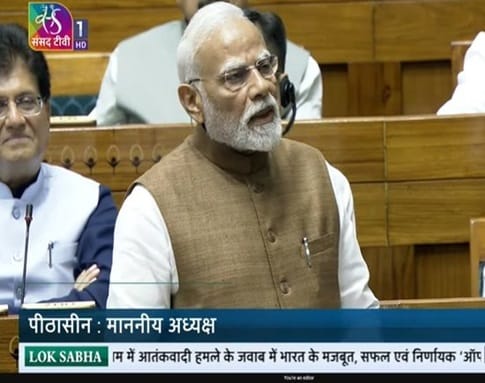
In a forceful reply during a special discussion in the Lok Sabha, Prime Minister Narendra Modi categorically rejected opposition claims that Operation Sindoor was halted due to international pressure, especially from the United States. “No global leader asked us to stop the operation,” Modi asserted, adding that it was Pakistan that pleaded for an end to India’s offensive. “We made our position clear to the US Vice President — if Pakistan attacks, India will respond strongly,” he said.
During a high-stakes debate in the Lok Sabha, Prime Minister Narendra Modi firmly rejected the opposition’s allegations that India agreed to a ceasefire with Pakistan under pressure from the United States. He clarified that no international leader had urged India to halt Operation Sindoor, and it was, in fact, Pakistan that pleaded with India to stop the operation, stating it could not withstand the offensive any longer. The Prime Minister said that in his conversation with the Vice President of the United States, India made it unequivocally clear that if Pakistan dared to strike, India would respond with full force.
The Prime Minister informed the House that Operation Sindoor was a decisive counter to the Pahalgam terror attack and saw Indian forces targeting and destroying terror camps located deep inside Pakistani territory. He claimed the operation sent a strong message to the world that India would not fall prey to nuclear blackmail and had the strength and resolve to respond to any aggression in its own way. He stated that India had avenged the 22nd terror attack within just 22 minutes, and made it clear that it does not differentiate between terrorist groups and the governments that support them.
Mr. Modi also highlighted India’s growing defence capabilities and technological advancements, stating that the drones and missiles used during the operation were indigenous and had exposed the limitations of Pakistan’s military hardware. According to him, India’s forces executed the strikes with precision, causing significant damage to Pakistan’s airbases and strategic assets. He lamented that while the world stood by India during this critical moment, the Congress party failed to support the Armed Forces and continued to play into narratives favorable to Pakistan. He accused the Congress of never having a clear national security vision and blamed its past governments for weak policies that cost many civilian lives to terrorism.
Home Minister Amit Shah also addressed the House, giving a detailed account of Operation Sindoor. He said that the operation was launched in the early hours of May 7 and lasted for just 20 minutes, during which nine terror sites located nearly 100 kilometres inside Pakistan were destroyed, and over 100 terrorists were neutralised. He noted that the attack was carried out with surgical precision and that no Pakistani civilians were harmed. Shah added that the decision to strike was based on solid ground intelligence, gathered through extensive questioning of over a thousand people, including victims’ families, locals, pony operators, and others in the Pahalgam region. The inputs led to the identification of two local collaborators, Bashir and Parvez, who had provided shelter to the terrorists.
The Home Minister sharply criticised Congress leader P. Chidambaram for seeking proof of Pakistan’s involvement, accusing him of virtually giving a clean chit to the perpetrators. Shah stated that the day Pakistan-based terror outfit Lashkar-e-Taiba claimed responsibility for the Pahalgam attack, the government handed over full operational control to the armed forces. He said Pakistan was left with no option but to seek a ceasefire as its offensive capabilities had been dismantled. Shah informed the House that Pakistan’s Director General of Military Operations contacted his Indian counterpart on May 10, after which the ceasefire was announced. He reminded the House that wars come with consequences, and every step must be weighed carefully.

The debate saw strong reactions from opposition leaders as well. Leader of Opposition Rahul Gandhi strongly condemned Pakistan for masterminding the Pahalgam attack and said the opposition had backed the government during the operation. However, he questioned why the Centre contacted the Pakistani government just 22 minutes after the strike and reportedly assured that military installations would not be hit. He accused the government of showing hesitation and lacking the will to pursue the operation to its logical end.
DMK MP Kanimozhi said that while the Home Minister made it sound like the opposition lacked patriotism, her party stood firmly behind national interest. Akhilesh Yadav of the Samajwadi Party questioned the motivations behind the ceasefire announcement and what pressure, if any, led to that decision. He also raised concerns about security lapses that made the Pahalgam terror attack possible and called on the government to take concrete steps to prevent such failures in the future. Priyanka Gandhi of the Congress acknowledged the Armed Forces’ role but held the government responsible for failing to ensure security in Jammu and Kashmir. She pointed out that no security personnel were present at the site of the attack and that the absence of medical facilities at the tourist hotspot made matters worse.
Shrikant Shinde of Shiv Sena, who led a delegation to several countries as part of India’s diplomatic outreach following the operation, said that many foreign governments commended India’s role in sensitising the world against terrorism, a testament to the success of India’s foreign policy. Sayani Ghosh of the TMC raised questions about how terrorists managed to reach a tourist hub undetected while the police couldn’t act in time. She called the Pahalgam attack a grave intelligence failure but lauded the precision with which the airstrikes were executed during Operation Sindoor.
BJP MP Nishikant Dubey reassured the House that every Indian life matters and that the NDA government will never spare terrorists. He also reiterated the belief that Pakistan-occupied Kashmir (PoK) would eventually become a part of India. However, DMK’s A. Raja alleged that despite warnings from RAW and IB, security measures were missing at the site. He also pointed out that no major international grouping like G20 or BRICS had officially passed a resolution supporting India. IUML’s E.T. Mohammed Basheer raised concerns about whether India still holds the same level of respect globally as it once did.
Congress MP KC Venugopal claimed that the terror attack was aimed at dividing India on religious lines and questioned whether a third party had intervened to broker the ceasefire — something unprecedented in India’s history. SAD’s Harsimrat Kaur Badal said that ceasefire was necessary to prevent the suffering of civilians living in border areas who are the worst affected during such conflicts. Dimple Yadav of the Samajwadi Party criticised the government for failing to anticipate the attack and demanded accountability. She questioned why the ceasefire announcement reportedly came from the US President instead of the Indian government.
Following the Prime Minister’s detailed reply, defending the operation and India’s national security posture, the Lok Sabha was adjourned to meet again the next day at 11 AM.
Home Minister Details Operation Timeline, Exposes Terror Links
Home Minister Amit Shah revealed that Operation Sindoor was carried out with surgical precision on 7th May between 1:04 AM and 1:24 AM, destroying nine terror bases located 100 kilometers inside Pakistan. Over 100 terrorists were eliminated, and Shah clarified that no Pakistani civilians were harmed.
Shah said the intelligence trail began with extensive questioning of over 1,000 people in Jammu & Kashmir, which led to the identification of two individuals, Bashir and Parvez, as those who sheltered the attackers. He criticised former Home Minister P. Chidambaram for seeking proof of Pakistan’s involvement, accusing the Congress of offering a clean chit to the enemy.
He reiterated the government’s Zero Tolerance Policy on terrorism and said Pakistan was left with no option but to request a ceasefire after its military capabilities were crippled.
Opposition Reactions: Support for Forces, but Questions for Government
Opposition leaders, while united in their praise for the armed forces, raised several concerns regarding the ceasefire, intelligence failures, and timing of the operation.
- Rahul Gandhi, Leader of the Opposition, condemned Pakistan for orchestrating the Pahalgam attack and said the opposition stood firmly with the government during Operation Sindoor. However, he criticised the government for allegedly reaching out to Pakistan just 22 minutes after launching the strike, implying a lack of resolve.
- Priyanka Gandhi questioned the security lapses that allowed the Pahalgam terror attack to happen on 22nd April, noting the absence of security forces and medical help at the site, despite it being a major tourist destination.
- Akhilesh Yadav (SP) questioned the rationale behind the ceasefire, demanding to know what pressure prompted it. He called the Pahalgam incident a glaring example of security failure.
- K. Kanimozhi (DMK) expressed displeasure over Shah’s remarks targeting the opposition’s patriotism, while affirming her party’s consistent support during national crises.
- Sayani Ghosh (TMC) called the Pahalgam attack a serious intelligence failure, questioning how terrorists could reach a tourist hub unnoticed.
- A Raja (DMK) alleged that despite prior warnings by RAW and IB, there was no security in place. He also claimed no major international group officially backed India after the strikes.
- KC Venugopal (Congress) raised doubts over third-party involvement in the ceasefire, saying this would be unprecedented in India’s history.
- Dimple Yadav (SP) criticised the government’s preparedness and sought accountability. She questioned why the ceasefire announcement reportedly came from the US President.
Defence of Government’s Approach
Several NDA MPs strongly defended the government’s actions:
- Shrikant Shinde (Shiv Sena) said India’s global outreach post-operation received overwhelming support and praised the NDA’s foreign policy.
- Nishikant Dubey (BJP) reiterated that the government will never spare terrorists and claimed that PoK would eventually return to India.
- Harsimrat Kaur Badal (SAD) said the decision to cease fire was also influenced by humanitarian concerns, with civilians along the border suffering the consequences of escalation.
- ET Mohammad Basheer (IUML) expressed concern over India’s diminishing global image, despite previous international regard.
House Adjourned Post Prime Minister’s Reply
After the Prime Minister’s assertive response defending the operation and laying blame on Pakistan for initiating hostilities and later begging for peace, the Lok Sabha was adjourned till 11 AM tomorrow.
This dramatic and high-voltage debate on Operation Sindoor has reignited discussions around India’s national security doctrine, the role of opposition in national interest, and the challenges of balancing strategic action with diplomatic imperatives.