
Last Updated on September 30, 2025 8:13 pm by INDIAN AWAAZ
AMN / Web Desk |
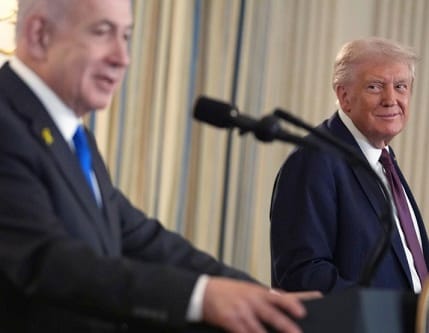
In a high-stakes announcement from the White House, U.S. President Donald Trump unveiled revealed a 20-point peace proposal aimed at ending the war in Gaza, now nearing its second year. Flanked by Israeli Prime Minister Benjamin Netanyahu, Trump declared, “If Hamas rejects the deal, Bibi, you’d have our full backing to do what you need to do”.
The plan outlines an immediate ceasefire, the release of hostages held by Hamas in exchange for Palestinian prisoners, a phased Israeli withdrawal from Gaza, and the disarmament of Hamas. It also proposes a transitional government led by an international body chaired by Trump himself, with former UK Prime Minister Tony Blair as a key member,
During this time, all military operations, including aerial and artillery bombardment, will be suspended, and battle lines will remain frozen until conditions are met for the complete staged withdrawal. The peace plans further stated that within 72 hours of Israel publicly accepting this agreement, all hostages, alive and deceased, will be returned. Once all hostages are released, Israel will release 250 life sentence prisoners plus 1700 Gazans who were detained after October 7th 2023, including all women and children detained in that context. Members of Hamas who wish to leave Gaza will be provided safe passage to receiving countries.
Upon acceptance of this agreement, full aid will be immediately sent into the Gaza Strip. As per the peace plan, a Trump economic development plan to rebuild and energise Gaza will be created by convening a panel of experts who have helped birth some of the thriving modern miracle cities in the Middle East. The United States will work with Arab and international partners to develop a temporary International Stabilisation Force (ISF) to immediately deploy in Gaza. The peace plan emphasised that the United States will establish a dialogue between Israel and the Palestinians to agree on a political horizon for peaceful and prosperous co-existence.
Netanyahu voiced strong support, stating, “This could be done the easy way or the hard way, but it will be done” However, internal dissent emerged, with Israeli Finance Minister Bezalel Smotrich calling the plan “a resounding diplomatic failure” .
Hamas, notably excluded from the drafting process, responded with skepticism. A senior official told Reuters the plan was “completely biased to Israel” and contained “impossible conditions” (MSN). Still, Hamas negotiators agreed to review the proposal “in good faith” and are expected to deliver a formal response to Egyptian and Qatari mediators by Wednesday.
The plan has garnered broad international support. Foreign ministers from Saudi Arabia, Jordan, UAE, Qatar, Egypt, and Turkey urged Hamas to accept the deal. European Commission President Ursula von der Leyen praised the initiative, saying, “Hostilities should end with provision of immediate humanitarian relief to the population in Gaza and with all hostages released immediately” (US News).
As the deadline looms, the region braces for Hamas’s response—a decision that could reshape the future of Gaza and the broader Middle East.