
Last Updated on April 6, 2026 10:16 pm by INDIAN AWAAZ
R. Suryamurthy
India’s state governments are poised to step up market borrowings in FY2027, a trend that could reshape domestic bond markets, tighten liquidity conditions, and test fiscal discipline even as capital expenditure ambitions remain intact.
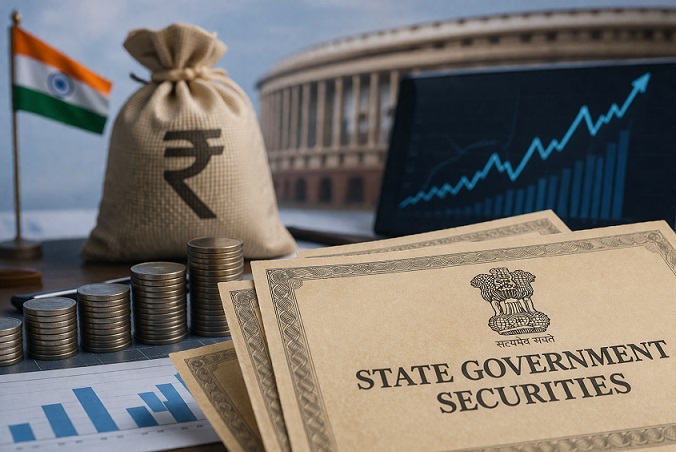
A latest assessment by ICRA Limited projects gross State Government Securities (SGS) issuance at ₹13.4–14.0 trillion ($160–167 billion approx.) in FY2027, marking a 5–9% rise over the previous year.
While the increase appears moderate on the surface, the implications are more far-reaching.
The higher borrowing calendar—front-loaded with a sharp 27% year-on-year jump in Q1 issuance—comes at a time when central government borrowing remains elevated.

Crowding-out risks intensify
This dual supply pressure is likely to keep yields firm, particularly in the long end of the curve. Analysts say state bonds, which already carry a spread over sovereign debt, could see that premium widen further, raising borrowing costs for fiscally weaker states.
The introduction of a benchmark issuance strategy by the Reserve Bank of India may improve liquidity and price discovery over time, but in the near term, the market will need to absorb a larger, more structured supply of paper.
Execution risks remain high
A persistent gap between indicated and actual borrowing—especially in the first quarter—points to administrative bottlenecks. Delays in borrowing approvals from the central government could once again push issuances into later quarters, reinforcing the back-ended borrowing pattern seen in recent years.
This has two implications: sudden supply spikes in the second half of the fiscal year and increased volatility in yields.
Fiscal discipline vs growth push
States are entering FY2027 with tighter guardrails. The fiscal deficit cap has been fixed at 3% of Gross State Domestic Product, with no additional borrowing flexibility.
However, New Delhi’s decision to extend ₹2 trillion ($24 billion) in interest-free capex loans provides a partial cushion, allowing states to continue infrastructure spending without breaching limits.
The trade-off is clear: states must balance politically driven spending—especially in election-bound regions—with the need to maintain fiscal credibility.
Concentration risk and political economy
Borrowing is becoming increasingly concentrated. West Bengal, Bihar and Uttar Pradesh alone account for nearly two-thirds of incremental Q1 issuance.
With some of these states heading into elections, borrowing patterns may reflect short-term spending priorities rather than long-term fiscal consolidation—raising concerns among investors about credit differentiation within the SGS market.
Outlook: Structural shift underway
Over the medium term, India’s state borrowing market is moving toward greater sophistication, with standardised maturities and improved transparency.
Yet, the near-term outlook is more complex. Elevated supply, tighter fiscal limits, and execution uncertainties could keep yields volatile, potentially crowding out private investment and raising the cost of capital across the economy.
For investors, FY2027 may mark a turning point—where state bonds evolve from a passive allocation to an actively managed risk segment within India’s fixed income landscape.