
Last Updated on November 3, 2025 7:00 pm by INDIAN AWAAZ
Zakir Hossain from Dhaka
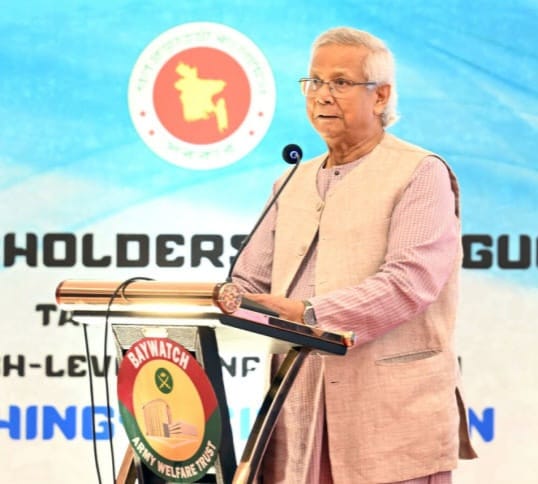
Bangladesh interim government has given political parties one week to reach a consensus on the disputed issues of the July Charter and the proposed referendum, warning that it will take unilateral action if talks fail. Law Adviser Asif Nazrul made the announcement after an emergency meeting of the Council of Advisers chaired by Chief Adviser Muhammad Yunus on Monday.
“Regarding the timing of the referendum— when it will be held and what its subject will be— as well as the steps to be taken in response to the notes of dissent in the July Charter, the meeting expressed the view that a final decision should be made urgently in line with the proposals made by the Consensus Commission,” Nazrul told reporters.
He said the government had called upon the long-time allied anti-fascist political parties to hold discussions among themselves and provide the government with a united guideline within the next week. “Given the current situation, there is no room for delay, and everyone must keep this in mind,” he said, adding that if the parties failed to settle their disputes, “the government will act on its own.”
The July Charter, drawn up by the National Consensus Commission following the fall of Sheikh Hasina’s regime in August 2024, outlines sweeping political reforms, including a two-term limit for prime ministers and greater presidential powers. While most major parties signed the document, several groups have insisted that its implementation be ratified through a referendum. Nazrul reaffirmed the interim government’s commitment to holding the next parliamentary election in the first half of February 2026, noting that the Council of Advisers had thanked the Consensus Commission and political parties for their efforts to build unity on reform issues.
However, serious allegations of corruption, money laundering, and abuse of power have now surfaced against Law Adviser Asif Nazrul himself, casting a shadow over the interim government’s credibility. According to reliable sources within the National Citizen Party (NCP), Nazrul has allegedly transferred large sums of money to foreign accounts in Singapore, Thailand, and other countries using intermediaries and informal channels.
A senior NCP leader, speaking on condition of anonymity, said, “Asif Nazrul has betrayed the spirit of the July Revolution. The scale of corruption he has indulged in as part of the interim government is beyond description. There’s no doubt he will have to face justice one day.”
Sources also claimed that Nazrul has allegedly used his influence within the Advisory Council to sideline or remove members who questioned his conduct or opposed his growing dominance. His rapid consolidation of power and alleged financial irregularities have reportedly caused unease across Bangladesh’s political and bureaucratic circles.
The NCP, in a formal letter signed by its Member Secretary Akhter Hossen, accused Nazrul of assuring a particular political party of advantages regarding proposed amendments to Article 20 of the Representation of the People Order (RPO) 1972— a move the party says undermines the neutrality expected from government advisers. “It must be remembered that amending such a law is not a unilateral decision—it is an institutional, consultative and public interest-driven process,” the NCP said, warning that such conduct “undermines public confidence in the administration and questions the impartiality of the interim government.” The party further urged the Law Adviser to clarify the government’s official position, arguing that any registered party contesting under another party’s election symbol “breaks the link between voters and political accountability.”
Political observers say the fresh controversy over Nazrul’s alleged corruption could weaken the Yunus government’s moral authority at a time when it is struggling to maintain unity among pro-democracy forces.
The government’s ultimatum to reach a consensus within a week, or face unilateral action, comes amid mounting tensions and suspicion among key stakeholders over the path ahead for Bangladesh’s fragile transition.