
Last Updated on April 14, 2026 10:47 pm by INDIAN AWAAZ
Zakir Hossain from Dhaka
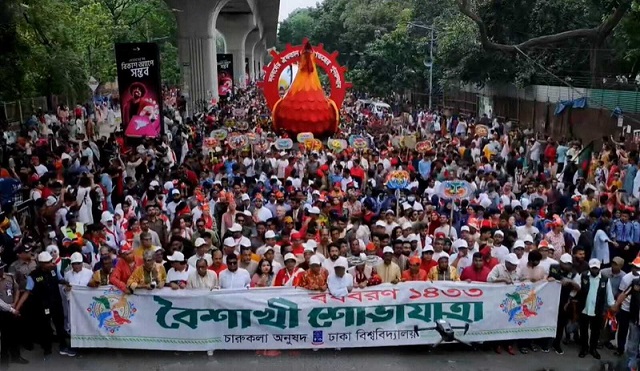
Thousands of people joined the traditional “Baisakhi Shobhajatra” in Dhaka on Tuesday to celebrate the Bengali New Year 1433, with a vibrant procession beginning from the Faculty of Fine Arts, Dhaka University, at around 9am. The event drew enthusiastic participation from people of all ages, including students and teachers, creating a festive atmosphere across the campus.
Celebrations began early at Ramna Batamul, where a cultural programme opened at sunrise with a collective rendition of “Jago Alok-Lagane”. A total of 22 performances were staged over two hours, concluding with the national anthem. This year’s Shobhajatra carried the theme “New Year’s Harmony, Democracy’s Resurgence”.
Five main motifs: rooster, elephant, pigeon, dotara and horse, featured prominently, along with depictions of fish, tiger and deer cubs, goats, cockatoos and peacocks. The rooster symbolised new beginnings, the dotara reflected folk traditions, the elephant stood for strength and heritage, the horse evoked rural simplicity, and the pigeon represented harmony and peace.
Participants also protested attacks on Baul communities and reaffirmed their commitment to a culturally inclusive Bangladesh.
The Shobhajatra, earlier known as Ananda Shobhajatra and Mangal Shobhajatra, was recognised by UNESCO as an Intangible Cultural Heritage of Humanity in 2016.
Meanwhile, Indian high commissioner Pranay Verma attended a cultural programme in Dhaka on Monday evening marking Chaitra Sankranti and the eve of the Bengali New Year. The event, organised by Itihas O Oitijjo Parishad at the Bangladesh National Museum, featured dances, Rabindra Sangeet, Nazrul Geeti, recitations and Jari music. Extending greetings, Verma said the festivities were an integral part of the shared cultural heritage of India and Bangladesh and helped strengthen people-to-people ties between the two countries.