
Last Updated on April 11, 2026 10:11 pm by INDIAN AWAAZ
Aafreen Hussain From Kolkata
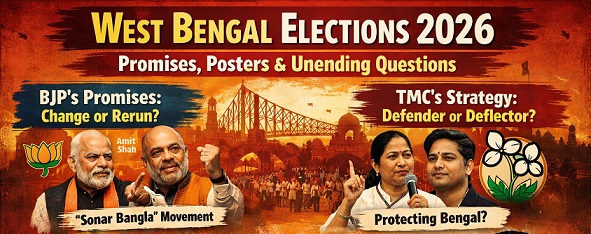
As West Bengal inches closer to the 2026 Assembly elections, the political stage looks less like a contest of ideas and more like a crowded theatre of recycled slogans, dramatic speeches, and strategic defections. From mega rallies to street-corner meetings, every party claims to be the true savior of Bengal—but the voters, seasoned and skeptical, seem to be asking sharper questions than ever before.
The BJP’s “New Promises” or Old Scripts?
When Amit Shah and Narendra Modi arrive in Bengal, the energy is unmistakable. Grand promises, sharp attacks on the ruling party, and visions of “Sonar Bangla” dominate their speeches. But here’s the uncomfortable question: After more than a decade in power at the Centre, are these promises a roadmap or a rerun? From jobs to infrastructure to law and order, critics—especially from the All India Trinamool Congress (TMC)—argue that the BJP’s manifesto sounds eerily familiar. Voters might wonder: If these were achievable, why are they still being promised?
TMC’s Counterattack: Defender or Deflector?
On the other side, Mamata Banerjee and Abhishek Banerjee continue to position themselves as Bengal’s protectors—against “outsiders,” against central neglect, and against political aggression. Their speeches often highlight welfare schemes, Bengali identity, and alleged injustices in BJP-ruled states. But again, the voter might pause and ask: Is governance being showcased, or is fear being mobilized? And if everything is working so well, why does anti-incumbency still whisper in the background?
The Left and Congress: Revival or Repetition?
The Communist Party of India (Marxist) and Indian National Congress alliance is trying to re-emerge as a credible alternative. They talk about unemployment, democratic rights, and the failures of both BJP and TMC. Yet, one cannot ignore the elephant in the room: Are they offering a fresh vision, or hoping voters forget the past? Can nostalgia win elections in a state that has already moved on twice?
The “Third Force” Puzzle
Then come the smaller but vocal players. Humayun Kabir and his shifting political alignments raise eyebrows more than expectations. Naushad Siddiqui and the Indian Secular Front attempt to carve out space among minorities and marginalized voters.But here’s the blunt question: Are these forces shaping the election or merely influencing margins? Do they represent ideological alternatives, or just electoral arithmetic?
Hoardings, Headlines, and Hypocrisy?
Across Kolkata and beyond, hoardings scream development, justice, and change. Each party accuses the other of corruption, violence, and betrayal. Meanwhile, professionals, students, small business owners, and farmers offer a more grounded perspective:
- A young graduate asks: “Where are the jobs beyond slogans?”
- A small trader wonders: “Why does every election feel like starting from zero?”
- A farmer questions: “Why do promises bloom only during campaign season?”
The Real Election: Narrative vs. Reality
The Bengal election of 2026 may ultimately not be about ideology alone. It may be about narrative control:
- BJP pushes a narrative of change.
- TMC pushes a narrative of protection.
- Left-Congress pushes a narrative of correction.
- Smaller parties push a narrative of representation.
But the voter stands at the center, quietly asking: Who is telling the truth, and who is just telling it better? Is this election about Bengal’s future or about political survival? And most importantly: after decades of alternating promises, is the voter still buying the script?
The Voter’s Silent Sarcasm
In a state known for its political awareness, fiery debates, and intellectual tradition, the loudest voice in 2026 might not be from a rally stage but from the silent skepticism of its people. Because perhaps the most sarcastic question of all is this: “If every party claims victory for Bengal, why does Bengal still feel like it’s waiting?”