
By Inder Vashisth
The Central Industrial Security Force (CISF) has formally taken over the security of the Namo Bharat Corridor in the Delhi-NCR region, marking a significant step in safeguarding India’s first high-speed regional transit system.
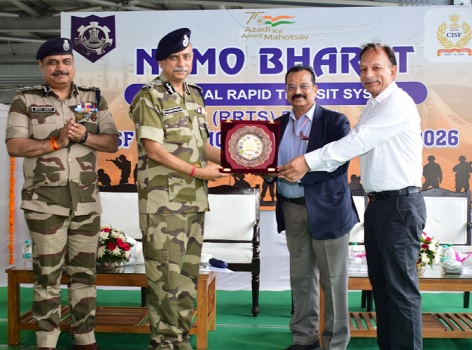
The security responsibility for the Regional Rapid Transit System (RRTS) Namo Bharat corridor was officially handed over to the CISF during a ceremony held on Tuesday at New Ashok Nagar in Delhi. The development marks the beginning of full CISF deployment to protect the advanced transit network, aimed at ensuring safe and seamless travel for passengers across the National Capital Region.
Speaking on the occasion, CISF Director General Praveer Ranjan said the deployment of CISF personnel on the Namo Bharat network represents a crucial step in securing India’s next-generation transportation infrastructure. He noted that as transport systems become faster and more interconnected, the approach to security must also evolve to become more advanced, integrated and technology-driven.
“The CISF is committed to providing a seamless, robust and passenger-centric security environment that not only protects critical infrastructure but also builds confidence among commuters,” he said.
251 Personnel Deployed
A total of 251 CISF personnel will be deployed to secure three stations in the Delhi section of the RRTS network—Anand Vihar RRTS Station, New Ashok Nagar RRTS Station and Sarai Kale Khan RRTS Station.
These stations form part of the first phase of the RRTS corridor, which includes 22 stations spanning Delhi and Uttar Pradesh. While the CISF will be responsible for security at the Delhi segment, the stations located in Uttar Pradesh will be secured by the Uttar Pradesh State Industrial Security Force (UPSISF).
Specialized Security Measures
The CISF is known for its specialised training in metro and transit security, which includes access control, passenger screening and crowd management. To ensure uniform security standards across the network, personnel of the UPSISF have also received training from CISF at the Delhi Metro Rail Corporation (DMRC).
The deployment of CISF personnel is expected to significantly strengthen the overall security architecture of the RRTS system. Security arrangements will include advanced surveillance systems, strict access control, anti-sabotage checks and rapid response capabilities to address any potential threats.
Infrastructure Support for Personnel
During the ceremony, the CISF Director General also performed the foundation ceremony for the construction of residential facilities for CISF personnel posted on RRTS duty. The housing project is expected to enhance infrastructure support for the force and ensure better operational readiness for those responsible for safeguarding the corridor.
The Namo Bharat corridor, part of India’s ambitious RRTS project, is designed to provide high-speed, reliable and efficient regional connectivity across the Delhi-NCR region, significantly reducing travel time between major urban centres while maintaining high safety and security standards.