
By Aafreen Hussain
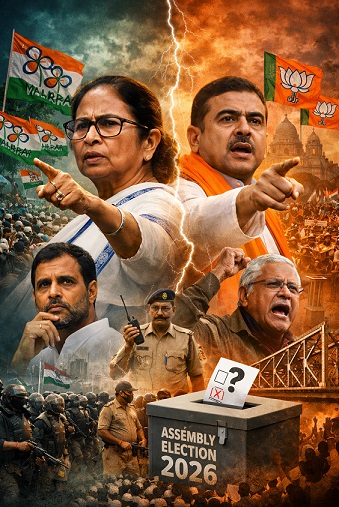
As West Bengal moves deeper into the 2026 Assembly election season, one question is echoing across the state: who is actually in a strong position? Is it the ruling Trinamool Congress, still banking on Mamata Banerjee’s personal appeal and organisational grip? Is it the BJP, trying to revive its Bengal dream with a more local strategy? Or is the so-called opposition space so fragmented that it is helping the ruling party more than hurting it? Recent developments show that the contest is intense, but the balance still appears tilted toward a few key players rather than all.
The TMC, despite anti-incumbency, still looks like the party with the strongest statewide machine. It has pushed a visible generational shift in its candidate selection, brought in younger faces, and is trying to refresh its image without surrendering Mamata Banerjee’s central leadership. At the same time, Mamata herself is heading into a high-voltage Bhowanipore battle against Suvendu Adhikari, making the election even more presidential in tone. So the first sarcastic question naturally arises: if TMC is supposedly so weak, why does every opposition strategy still begin and end with Mamata Banerjee?
The BJP remains the principal challenger, but it is still fighting two battles at once one against TMC, and another against its own past overdependence on imported faces and top-heavy campaign politics. Reports suggest the party has changed strategy and is now leaning more on local, grassroots figures. That sounds practical, but it also raises a biting question: after years of claiming Bengal was just one final push away, why is the BJP still “resetting strategy” instead of entering as the clear front-runner? If a party has to repeatedly explain its new formula, does that show strength or confusion?
Congress and CPI(M), meanwhile, continue to speak the language of anti-TMC and anti-BJP politics, but the real question is whether they still possess enough booth-level energy to convert speeches into seats. Their ideological line may still attract sections of urban dissenters, students, and traditional anti-BJP voters, but are they genuinely shaping the main battle, or merely commenting on it from the sidelines? Can a weakened Left-Congress space claim to be a serious alternative when the public conversation is still dominated by TMC versus BJP? Or is moral superiority now being used as a substitute for electoral strength? Recent coverage of candidate announcements and the election atmosphere suggests that the central spotlight remains overwhelmingly on TMC and BJP, not on a Left-Congress surge.
The Election Commission’s aggressive transfers of IAS and IPS officers, the deployment directions involving central forces, and the wider security focus show one more thing clearly: Bengal remains a politically volatile battlefield where administration, law and order, and perception management will matter almost as much as ideology. Which leads to another sharp question: if every election in Bengal must come wrapped in extraordinary supervision, then who exactly is benefiting from the atmosphere of permanent confrontation? The voters or the parties that thrive on polarization?
At this stage, the strongest position appears to be with the TMC in terms of organisation and statewide control, while the BJP remains the only opposition party with the scale to seriously threaten it across large parts of the state. Congress and CPI(M) may still influence outcomes in pockets and may cut into anti-incumbent votes, but they do not yet appear to command the same statewide momentum as the top two players. That makes the biggest irony impossible to ignore: is Bengal really witnessing a multi-cornered contest, or just another election where smaller opposition forces make speeches while TMC and BJP take the real fight to the ground?
In political terms, then, the hierarchy currently looks clearer than many would like to admit. TMC looks strongest structurally. BJP looks strongest among challengers. Congress and CPI(M) look more relevant in argument than in raw momentum. And that leads to the final sarcastic question: if the opposition truly believes Mamata Banerjee is vulnerable, why does it still look so divided, so reactive, and so dependent on TMC’s mistakes rather than its own strength? In elections, outrage makes headlines, but only organisation wins booths. And in Bengal, booths still decide history.
Last Updated on: 27 March 2026 12:04 AM